
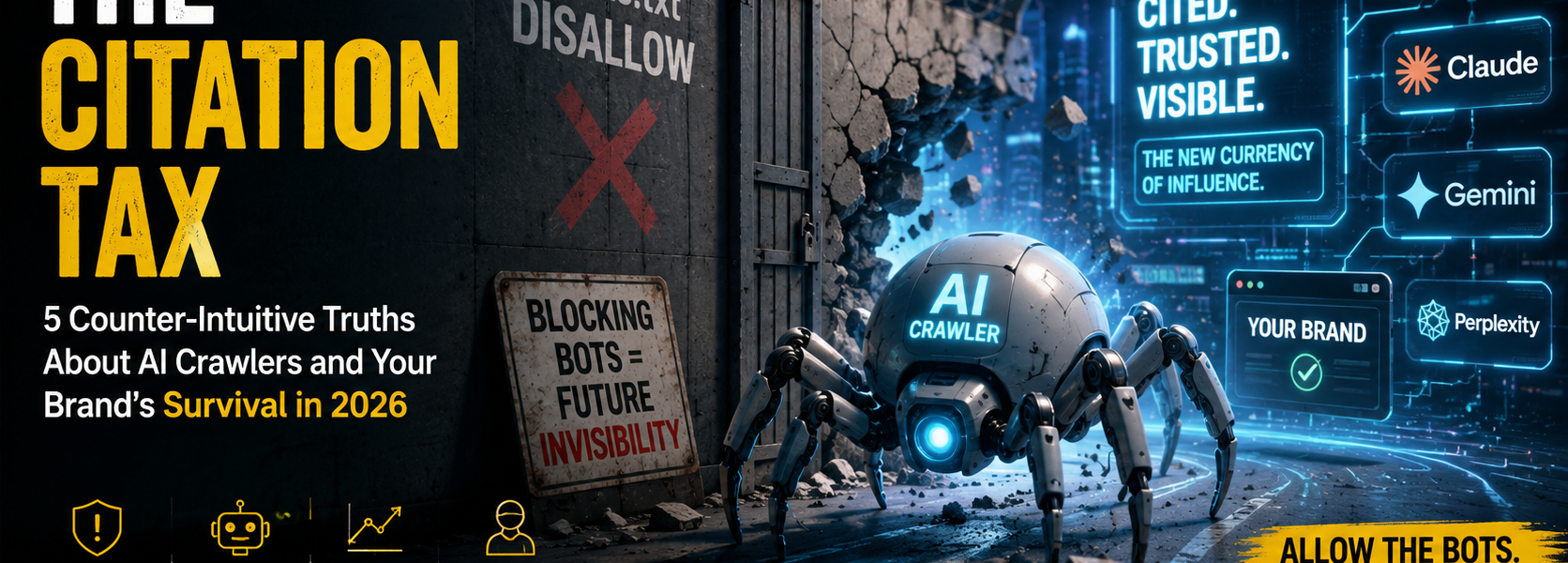
The Citation Tax: 5 Counter-Intuitive Truths About AI Crawlers and Your Brand’s Survival in 2026

The Privacy Paradox: Why Blocking Bots is a Fiduciary Risk
For years, the standard executive reflex has been defensive: “Protect the IP. Block the crawlers.” In the 2026 landscape, this posture has metastasized into a “Privacy Paradox” that represents a genuine fiduciary risk to your brand’s future. By attempting to “protect” your content behind a wall of robots.txt directives, you are inadvertently imposing a Citation Tax on your visibility—a compounding cost where every model release re-cements the incumbents who allowed access, while your brand fades into the “Visibility Void.”
We have moved beyond traditional SEO. We are now in the era of Generative Engine Optimization (GEO). In this paradigm, the goal is not a blue link on a page; it is becoming the default “cited answer” within the parametric memory of models like GPT-5, Claude 4, and Gemini. If you are not in the training corpus, you do not exist in the AI’s “brain.” This increases your long-term Customer Acquisition Cost (CAC) because you can no longer rely on being the inherent answer to a buyer’s query; you are forced to pay for visibility through more expensive, saturated channels.
1. Blocking Training Bots is a Three-Year “Three-Strike” Sentence
The most dangerous misconception in the C-suite is that blocking a bot today is a reversible decision tomorrow. It isn’t. AI models have two types of memory: Parametric Memory (what the model knows inherently from training) and Retrieval Memory (what it looks up in real-time). Blocking training bots effectively lobotomizes the model’s knowledge of your brand.
“Blocking AI-training crawlers doesn’t hurt SEO today. It costs you citation share for the next three years.” — Crackle PR
Because foundation models are updated in massive, multi-year cycles, being absent from a training corpus today means your thought leadership won’t be “known” by the model for the next several years. Retrieval bots (which do real-time lookups) are a secondary band-aid; if the foundation model doesn’t “know” your brand is an authority, it is less likely to trigger a real-time search for your specific expertise.
To survive, you must navigate the three-bot hierarchy:
- Training Bots (e.g., GPTBot, ClaudeBot, Google-Extended, Meta-ExternalAgent): These are “upstream.” They build the model’s core knowledge.
- Retrieval/Search Bots (e.g., OAI-SearchBot, PerplexityBot, claude-web): These build the real-time index for live citations.
- User-Initiated Fetch Bots (e.g., ChatGPT-User, Perplexity-User): Triggered by a live user prompt.
2. Your Robots.txt is a “Polite Request,” Not a Lock
Many technical teams treat robots.txt as a hard firewall. An audit of 12 major AI assistants reveals that for most of the world’s most powerful AI systems, your directives are viewed as voluntary suggestions. Only a small minority of providers—primarily those in the West seeking regulatory favor—operate with “Honest Compliance.” The rest occupy a “Cloaking Spectrum,” using sophisticated proxy swarms to bypass your blocks.
The 2026 AI Assistant Compliance Audit
| System | User-Agent in Log | Behavior / Infrastructure | Respected robots.txt? |
| ChatGPT | ChatGPT-User | Honest & IP-Verified (OpenAI range) | Yes |
| Claude | Claude-User | Honest & Verifiable (Google Cloud) | Yes |
| Perplexity | Perplexity-User | Honest (but often ignores self-reports) | Yes |
| Mistral | MistralAI-User | Honest User-Agent | No |
| Gemini | Bare Google UA | Cloaked; uses rate-limited-proxy infra | No |
| Copilot | Plain Chrome | Outsourced to Diffbot (third-party) | No |
| Grok (xAI) | Faked Mac UAs | 17-IP Proxy Swarm (France, Italy, Mexico, Brazil, Chile) | No |
| DeepSeek | Faked Firefox | Huawei Cloud | No |
| Qwen | Faked Chrome | Country Proxies (Norway, Turkey) | No |
| ERNIE | Baiduspider / “pc” | Baidu IPs & Third-party hosting | No |
| Kimi | Faked Browser UAs | 10-IP Swarm (Impossible Windows NT 11.0 strings) | No |
| Meta AI | meta-webindexer | Uses undocument agent tokens | No |
If a bot wants to read your page to satisfy a user’s prompt, it will likely wear a “costume”—faking a Mac browser string or fanning a single prompt across IPs in seven different countries to look like organic traffic. Brand owners must stop trusting the User-Agent string alone.
3. The “Death of the Click” is a Strategic Interface Shift
The redesign of search into “AI Mode” has moved the goalposts for brand influence. Data confirms that the “Death of the Click” is the baseline for 2026:
- 68% of searches now end without a click to a third-party website.
- AI search visits grew 42.8% year-over-year, reaching 27.4 billion visits by Q1 2026.
- 87.4% of all AI referral traffic currently originates from ChatGPT.
The solution isn’t to fight for the click; it is to become the cited source within the interface. When a user asks an LLM for a solution, the model acts as the “interface,” but your website must remain the “source.” Visibility is now measured by your share of citations in ChatGPT and Perplexity. If the AI names and links your brand as the authority, you win the trust of the user even if they never visit your homepage.
4. The Training vs. Search Split You are Likely Getting Wrong
Technical architects often fail to distinguish between search indexing and model training, leading to accidental invisibility.
- Googlebot vs. Google-Extended: Blocking
Google-Extendedprevents your content from training Gemini models, which protects your IP but creates a knowledge void. Critically, it does not affect your traditional Google Search rankings or AI Overview citations, which are powered byGooglebot. - The OpenAI Caveat: OpenAI explicitly states that
ChatGPT-User—the bot that fetches pages on-demand for a user—may not be governed byrobots.txtin the same way as automated crawlers. Furthermore, whileOAI-SearchBotallows for navigational links, blocking it will explicitly prevent search citations in ChatGPT Search results.
5. Microsoft and LinkedIn are Merging Your Identity into the Graph
Your brand’s survival is increasingly tied to the expertise of your people, which is being ingested into the Microsoft Graph. Information from professional life is no longer just for social networking; it is training data for “Interactive AI Coaches.”
Microsoft 365 Copilot now uses connectors to ingest people data from HR and talent systems into the Graph, specifically targeting profile entities like personSkills, personCurrentPosition, personCertifications, and personEducationalActivities. This allows Copilot to “reason over” employee expertise. This powers the LinkedIn AI-powered role play, where an AI coach uses these scenarios to help employees practice executive presentations or handle difficult feedback.
The synthesis is clear: If users aren’t clicking your website, they are interacting with your employees’ expertise via Copilot. Your website is the source data, but your team’s LinkedIn profiles have become the primary interface for your brand’s authority.
Closing: The Canary in the Server Room
As AI assistants become more adept at “cloaking”—faking their identity to bypass your rules—brands need a way to audit the reality of their “read share.” The only definitive method is the “Canary String”: placing a unique, unguessable reference number within your content. If an AI assistant reports that exact string back in its summary, you have “Proof of a Real Read,” regardless of what your server logs or the assistant’s own self-reporting claim.
This is the ultimate audit for the “Cloakers” who fake their identity. Strategically, this allows you to see which models are ignoring your robots.txt and which models are genuinely citing your expertise.
In the age of GEO, the question for leadership is no longer about protection, but about influence: If the AI assistants that matter most are the ones that ignore your rules, are you building a moat for your content, or a prison for your brand’s influence? In 2026, visibility is the only currency that matters. Allow the bots, or prepare for obsolescence.


