
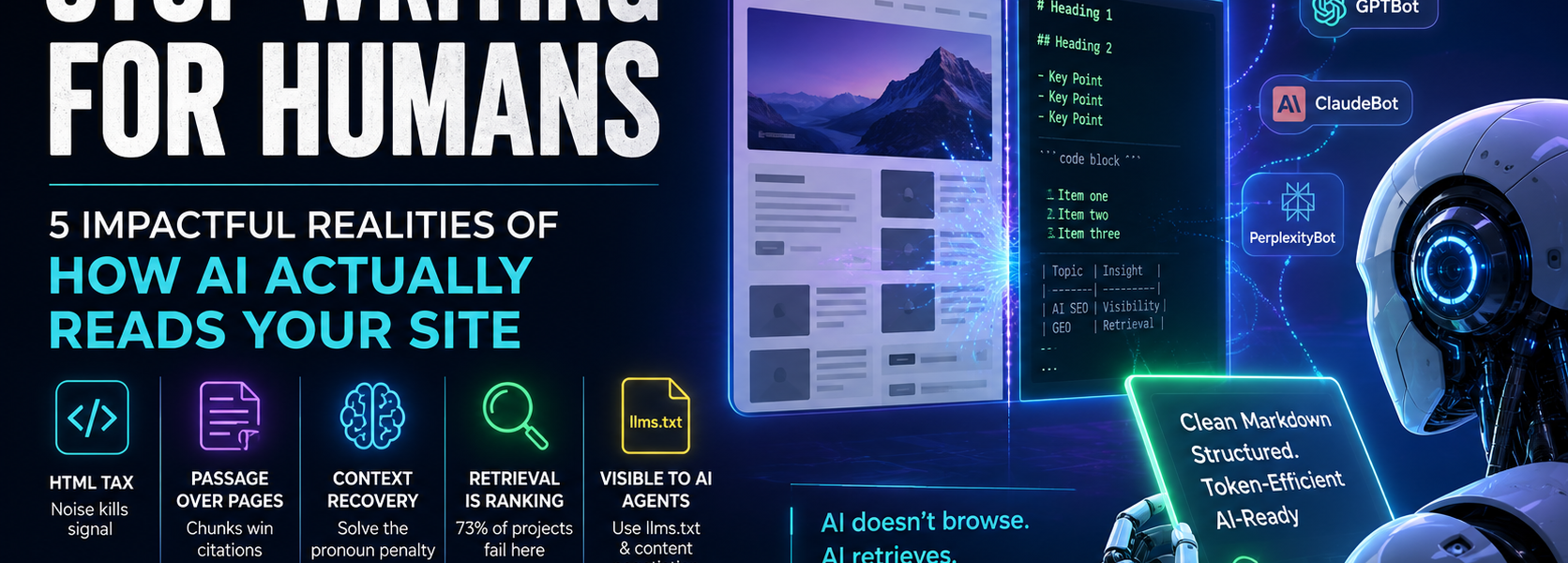
Stop Writing for Humans: 5 Impactful Realities of How AI Actually Reads Your Site

The “Coffee-Spilling” Realization: An Introduction
A few months ago, a creator opened their Cloudflare analytics and almost spilled their coffee. The “visitors” weren’t humans clicking blue links; they were machines. Googlebot was there, but so were ClaudeBot, GPTBot, and PerplexityBot. In the agentic web of 2026, a significant portion of your “traffic” never intends to visit your page. The AI simply eats your snippet, synthesizes the answer, and walks away.
As a Senior Retrieval Engineer, I see this shift every day. Many organizations are still optimizing for a 2018 human-centric SEO playbook, obsessing over keyword density and Lighthouse scores. But in a world dominated by Large Language Models (LLMs), traditional SEO is being demoted by Generative Engine Optimization (GEO) and Answer Engine Optimization (AEO). The hard truth is that retrievability is the new crawlability. If your content isn’t structured for machine ingestion, it effectively doesn’t exist to the agents that now control the click.
Takeaway 1: The “HTML Tax” and the Noise-to-Signal Disaster
In AI, the fundamental unit of measurement is the token. Every wasted token is a “tax” on your visibility. LLMs have limited context windows and operational costs defined by these units. When an AI agent ingests a site, a “noise-to-signal” disaster occurs if that site is buried in modern HTML.
Consider the phrase “Hello World.” In plain text, this is roughly 3 tokens. In a standard HTML environment—encased in div tags, CSS classes, and Tailwind component trees—that same phrase can balloon to over 60 tokens. This 20x tax forces models to work twenty times harder to extract meaning. To an AI, a site filled with “div confetti” and sticky navs is the equivalent of a 400-page legal contract written in Comic Sans.
Furthermore, we must account for the “Context Cliff.” Research suggests that at approximately 2,500 tokens, the quality of LLM reasoning begins to degrade. If 90% of those tokens are redundant HTML boilerplate, the model falls off that cliff before it even reaches your core value proposition.
Directive for your internal systems: Markdown is the “native tongue” of AI agents. It is structured enough to preserve semantic relationships (headings, lists, code) but compact enough to be token-efficient. Every engineering team should prioritize serving clean Markdown—stripping navbars and footers—to ensure the signal survives the noise.
Takeaway 2: The End of the Webpage—It’s All About “Passages”
AI search engines (Perplexity, ChatGPT, and Google AI Overviews) no longer rank your site as a single cohesive unit. They utilize Passage Level Retrieval, where content is broken into independent chunks of 100–300 words. These chunks are scored and retrieved based on their semantic relevance to a specific query, regardless of the overall page’s strength.
This shift transforms “Position Zero” into an AI Citation. To secure these citations, you must move beyond “Fixed-size” chunking (splitting by character count) and adopt Semantic Chunking. This means organizing content into complete, coherent thoughts that an AI can extract without losing the surrounding logic.
The data is clear: structured, passage-optimized content earns 2.3x more featured snippet placements than unstructured pages of equal authority. The goal is no longer to build a “page” but to build a library of self-contained knowledge units.
Takeaway 3: The “Pronoun Penalty” and Technical Context Recovery
When chunks are separated from their parent document, they often suffer from context loss. Consider the sentence: “The company’s revenue grew by 3%.” If the agent retrieves this chunk without the preceding paragraph mentioning “Apple,” the data is accurate but unfindable because the entity is missing. This is the “Pronoun Penalty.”
To solve this, we use the Pinecone Human Readability Rule: If a chunk doesn’t make sense to a human without the surrounding context, it won’t make sense to an LLM. We address this through two high-level engineering patterns:
- Contextual Retrieval: Using a small model to “situate” every chunk. For roughly $1.02 per million document tokens (utilizing prompt caching for affordability), we prepend a 50–100 token sentence to each chunk: “This chunk is from the Apple Q3 earnings report regarding revenue growth.” Anthropic reports this reduces retrieval failures by up to 67%.
- Late Chunking: A sophisticated method where we pass the whole document through a transformer first. By pooling token vectors after a full pass, the embeddings for “the company” already carry the context of “Apple” from five pages earlier.
Takeaway 4: Retrieval is the New Ranking (And 73% of Projects are Failing)
The success of your AI strategy is no longer determined by the LLM’s generation capability, but by the retrieval step. Enterprise-scale research by Barnett et al. (arXiv 2401.05856) found that 80% of enterprise RAG (Retrieval-Augmented Generation) projects fail in production. Crucially, 73% of those failures originate in retrieval, not the generation step.
There is a stark accuracy gap between data types:
- Governed Data: Achieves 85–92% accuracy.
- Ungoverned Data: Plummets to 45–60% accuracy.
Most teams attempt to fix hallucinations by upgrading to a more expensive model, but improving retrieval on an ungoverned knowledge base is optimizing the wrong layer. If your knowledge base is stale or conflicting, you are simply retrieving the wrong answer with higher precision.
Takeaway 5: The “Invisible” Doorway—llms.txt and Content Negotiation
To bridge the gap between human aesthetics and machine efficiency, top-tier platforms like Vercel and Stripe are adopting two standards:
1. Content Negotiation: Using the 27-year-old HTTP Accept header, a server can detect the nature of a visitor.
- Human Browser:
Accept: text/html→ Serve the pretty site. - AI Agent:
Accept: text/markdown→ Serve the clean, token-efficient data.
2. llms.txt: This is the robots.txt of the AI era. Located at your domain root, llms.txt is not just a list of links—it is a hand-curated table of contents specifically for LLMs. It defines the “shape” of your site, guiding agents toward “ground truth” summaries while ignoring the clutter of your conversion funnel.
Conclusion: The Future of the Agentic Web
The web is fundamentally transitioning from a collection of “pages to be ranked” to a global library of “retrievable knowledge units.” In 2026, every page you publish has three distinct readers: a human, a search crawler, and an AI agent. Each requires a different level of structural clarity to be effective.
The principles of authority and experience (E-E-A-T) haven’t changed, but the delivery mechanism has. If your data remains a black box of unstructured HTML, it will become invisible to the engines that now answer the world’s questions.
Closing Question: If an AI agent visited your site today with a 500-token budget, would it find a definitive answer, or just a pile of <div> confetti?