
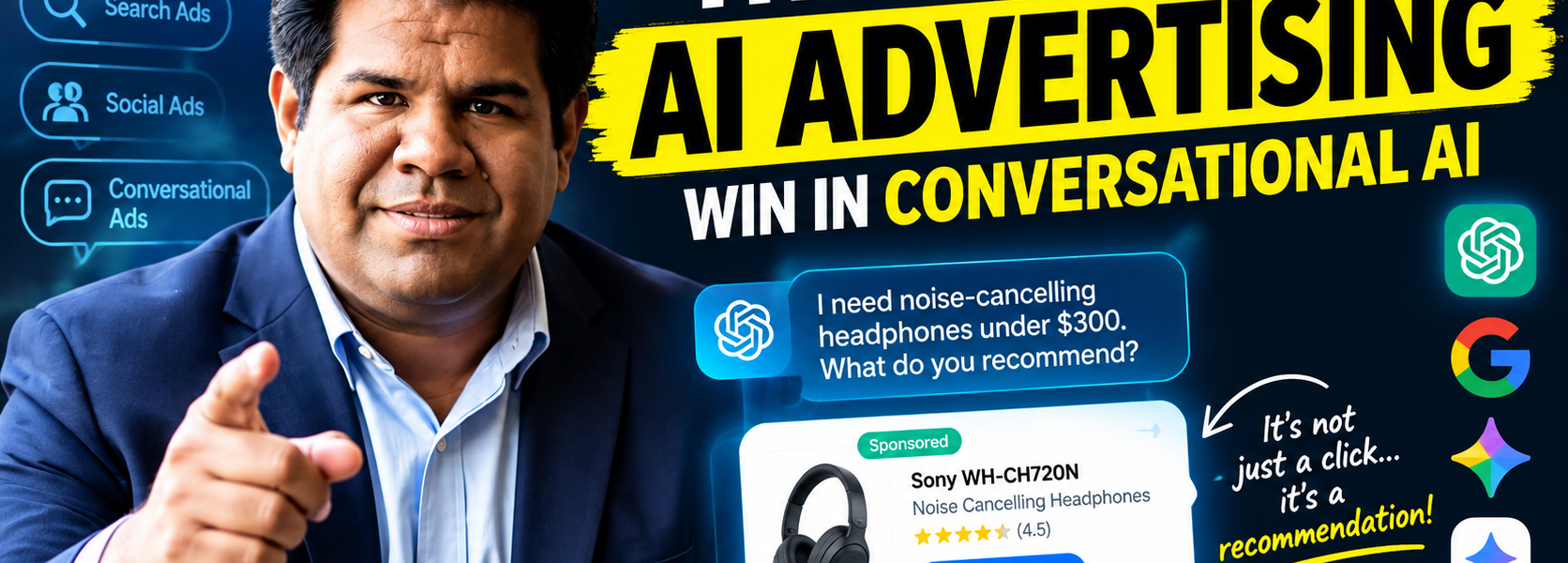
The Future of AI Advertising: How Brands Will Win in Conversational AI

Digital advertising is entering a new phase.
Instead of simply searching for a keyword, consumers can now describe what they need, explain their preferences, add constraints, compare options, and ask an AI assistant to help them make a decision.
That changes advertising.
In this episode of Marketing with AI, Rohit Shetty explores how conversational advertising could reshape the relationship between brands, consumers, and digital platforms.
The episode examines why advertising inside AI assistants is fundamentally different from traditional search and social advertising. Search advertising traditionally targets keywords, while AI assistants can interpret a user’s broader story—including intent, context, constraints, and preferences.
This creates a new opportunity for brands: becoming relevant enough to earn a place inside the recommendation.
What You’ll Learn
The episode explores the emerging role of sponsored recommendations in conversational environments and why successful AI advertising will need to be contextual, explanatory, useful, and clearly identified as advertising.
It also examines why user trust could become one of the most important competitive advantages in AI advertising. If consumers believe paid placements are influencing an AI’s organic response, confidence in the entire experience can suffer.
For marketers, this means preparing products and content so AI systems can understand what a brand offers, who it serves, and why its products are different.
The episode also outlines five practical priorities for brands:
- Build for conversational intent.
- Create structured product information.
- Make landing pages AI-readable.
- Develop recommendation-ready creative.
- Protect user trust.
The larger shift is from competing for impressions and clicks to competing for relevance inside the decision-making process.
As AI becomes a new layer in the marketing funnel, brands need to rethink how they communicate product value—not only to people, but also within the AI systems helping people make decisions.
3 Key Takeaways
1. Conversational intent changes advertising
AI assistants can interpret detailed questions containing context, constraints, preferences, and purchase intent. Brands need to understand the questions customers ask before they buy—not just the keywords they search.
2. AI-readable product information will matter
Brands should clearly communicate product features, use cases, differentiators, and supporting evidence. AI systems need information they can understand and confidently use when evaluating products.
3. Trust is a competitive advantage
Conversational advertising must be transparent. Clearly distinguishing sponsored recommendations from organic AI responses is essential to maintaining user confidence and trust.
The Big Idea
Traditional search asks: “What are you looking for?”
Social asks: “What interests you?”
AI asks: “How can I help you get there?”
That creates an entirely new layer in the marketing funnel—and a new form of advertising where the most valuable real estate may not be at the top of a page, but inside the answer.
Listen to the full episode of Marketing with AI to understand how conversational advertising could change the way brands compete for consumer attention, relevance, and recommendations.


